Drawing on her experience as a leftist feminist organiser in Lebanon and Syria, Naya reflects on the alliances and tensions between the left and queer movements, exploring the role of care and solidarity in building a liberation that leaves no one behind.
Introduction: Queerness Expands the Scope of Revolution
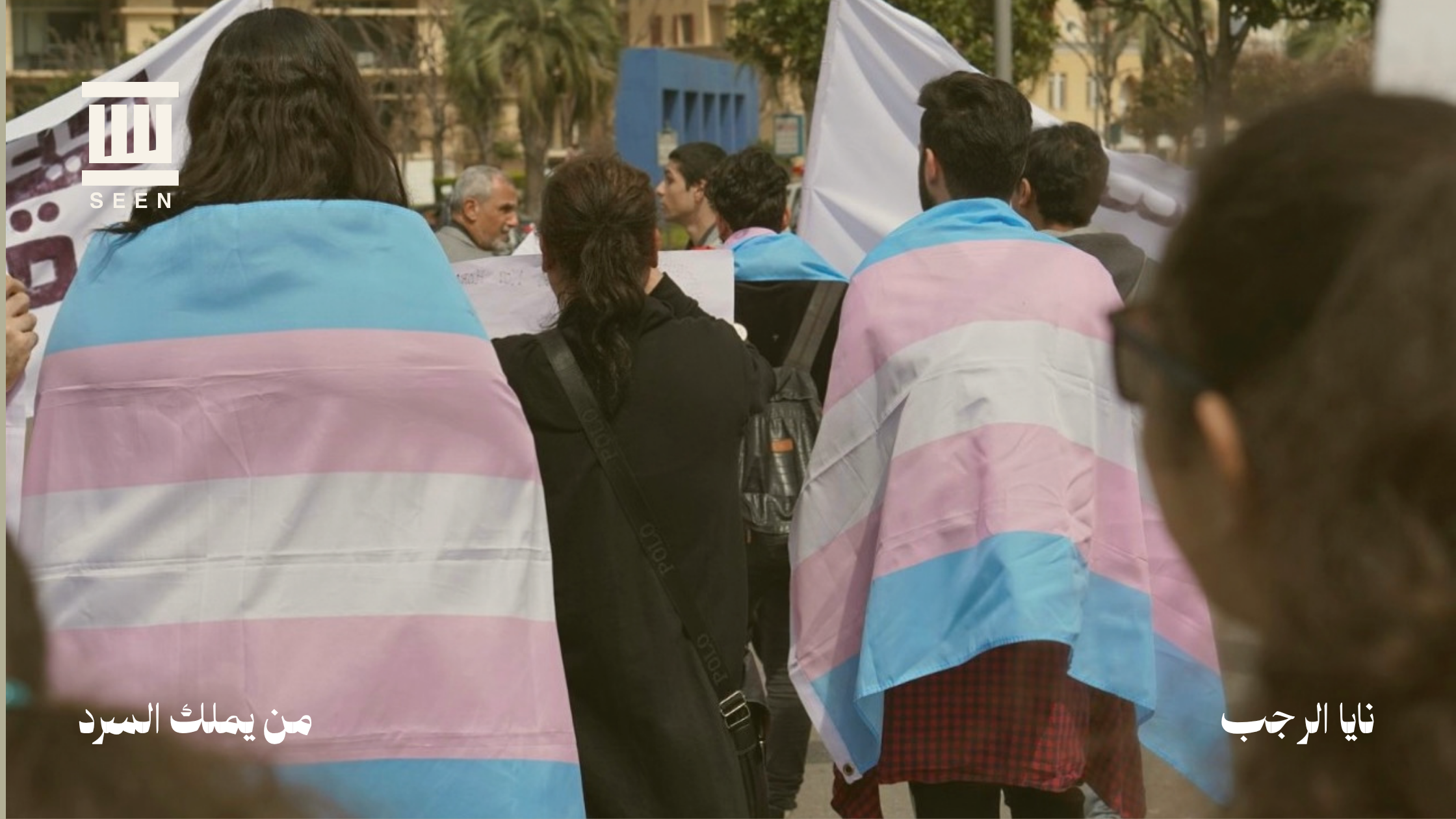
At an International Women’s Day march nearly eight years ago, trans women carried the trans flag with their bodies, chanting in the face of a patriarchal system that had long sought to make them disappear. Their presence was not merely symbolic; it was a direct confrontation—a body telling the street that it was here, and that it would not return to the shadows. I remember that day well because I was there, chanting with them: “We are, we are the trans women—against patriarchy, we revolt!” I was leading rows of women and trans women demanding a place for ourselves in this world, one that does not impose politics upon our bodies or require us to surrender a part of ourselves in order to deserve it.
This presence has roots far older than that day. In 2001, when the Cairo 52 incident unfolded, bringing repression and suffering upon Egyptian gay men, a group of people came to believe that silence was no longer an option for many queer people, and that scattered individual efforts could neither protect them nor transform a system structured around repression, violence, and the degradation of human dignity. They were feminists, leftists, gay men, and trans women, united by the conviction that their struggle could not be separated from the broader struggle for social justice. This intersection was not a tactical choice or an attempt to expand a support base. It reflected an early recognition that the oppression targeting queer bodies, the working class, and women emerged from the same instrument of power: a state that monopolises the right to define who counts as a “good citizen” and who is deemed disposable. From this understanding, and everything built upon it, Helem was born in Beirut: a movement political at its core from its very first day, struggling simultaneously for queer rights and broader civil-society causes.
Years later, specifically at the moment when Mohamed Bouazizi set himself on fire, we found ourselves across the entire region inside a revolutionary landscape far greater than the boundaries of any single capital. As gay people, trans women, women, and socialists—and, of course, as part of broader populations and working classes stretching from Tunisia to Egypt, Syria, Iraq, Lebanon, and Sudan—we were in the streets alongside everyone else. We demonstrated beside them and placed at the service of that revolutionary moment tools that were not always available to others: sustained organising, international advocacy, mobilisation, and lobbying that did not stop at the borders of a single country or community.
Over the past five years, this space has widened even further. Queer movements have raised their voices for Palestine, for Sudan, and for struggles elsewhere in our region that may not, at first glance, appear to be “our” struggles: violence against women, the exploitation of domestic workers, and the rights of refugees. We have said clearly that we are not separate from these struggles. They intersect with our own liberation, and we work and struggle for them just as we struggle for ourselves, seeking genuine justice for all people and communities. This has been evident in our practices, in the streets, and in every space in which we have organised ourselves.
All of this work—in the streets, within organisations, and throughout solidarity networks—carried within it a question we never stopped asking: how does the system that oppresses us actually function? Who benefits from keeping us at the margins, alongside women, workers, and refugees? We could not understand our oppression without understanding capitalism, the state, class relations, and the formation of the nation-state. Both capitalism and the modern state require, in order to reproduce themselves, bodies that are cheap, invisible, or placed outside legal protection: a domestic worker without a contract, a refugee without papers, a queer body without recognition. These were never merely parallel coincidences. They are interconnected functions of a single system that measures the value of life according to its usefulness—or its threat—to the system’s continuation. Understanding this interconnectedness is not a theoretical exercise or a discussion intended merely to sharpen our analytical capacities. It is what explains why no liberation can ever be partial.
It is from this understanding that I return to Syria, where most of this article will focus on rethinking the methods of our liberation and our struggle. Syria today, after everything it has endured, needs the relationship between the left, queer movements, feminist movements, and civil spaces to be rebuilt and reshaped—on the basis of our own experiences, lessons, and defeats. This is what this article attempts to do: How does queerness expand the revolution? And how do we begin where the system itself begins—with the family, an institution that appears to be among the warmest and most private aspects of life, while simultaneously functioning as one of the system’s most efficient instruments?
Historical Context: Marxism, the Family, and Reproduction
During one of the discussion sessions of a cadre circle at the Socialist Forum in Zico House, we sat in a circle in a room no larger than four metres by four, surrounded by books and pamphlets, discussing an article on Engels’s understanding of the family. The point that held our attention for a long time was both simple and unsettling: the heteronormative “nuclear” family, in its supposedly “natural” form that no one is expected to question, is neither a biological nor a moral given. Rather, it emerged historically alongside private property itself.
In The Origin of the Family, Private Property and the State, Engels argued that monogamous marriage did not emerge to sanctify love, but to guarantee men’s control over women’s bodies and sexual lives, and to ensure that wealth could be passed with certainty to “legitimate” heirs. I remember thinking that day of how many times I had heard the phrase, “That’s just how it has to be,” in relation to marriage and reproduction, without anyone daring to ask: It has to be this way for whom? And in whose interest, exactly?
The function of the family, as we discussed that day, was not merely to produce a new generation of workers. It was also a machine that prepared every individual within it for a predetermined role, with almost industrial precision. From childhood, a girl is prepared to become a “good wife”: to learn when to remain silent, to master the care of her husband, children, and home without this ever being called “work.” As long as it is named “love,” there is supposedly no need for wages, recognition, or even acknowledgement.
The family, meanwhile, prepares boys to become productive workers outside the home, to carry the family name, and to inherit whatever remains of its property. Yet this division cannot function in isolation; it requires a daily fuel that sustains it. Who cooks for the worker? Who washes his clothes? Who raises his children without being paid? This unpaid domestic labour, historically attached specifically to women’s bodies, is the hidden pillar that enables the family to perform its functions in the first place: reproducing workers, transmitting property, and entrenching obedience.
It was precisely here that my own question began to take shape: Why does this system require that this labour be performed specifically by a woman within a heteronormative household? What if the person cooking, raising children, and providing care were an effeminate gay man, or a trans woman? Would the system accept that arrangement with the same ease? Or is its rejection of queerness not merely moral or religious, as it is so often presented to us, but also rooted in an explicit economic anxiety over the disruption of a mechanism that functions only through this particular arrangement?
A family that does not produce “legitimate” heirs and does not guarantee a predictable cycle of production and reproduction does not serve the system with the same efficiency, regardless of how much care and love exists within it.
For me, this analysis was never merely a theoretical framework encountered in a book. It was a mirror of my own home and of questions that had been forming in me since childhood—questions that would later become clearer as I entered civil society and organising work.
From this same understanding, social reproduction theory developed a deeper argument: the reproduction of labour power is not simply a biological act. It is an entire social and economic process, largely sustained by women working without pay inside their homes. Cooking, cleaning, caring, listening—all of this is real labour that keeps the capitalist system functioning, yet it is erased from virtually every economic calculation because it is called “love” rather than “work.”
At precisely this intersection, between the question I had asked myself and this broader theoretical framework, it becomes clearer why the queer body in particular disrupts this machinery. It is a body that may refuse marriage in its “normative” form, refuse reproduction in the “expected” manner, or refuse to remain within the boundaries of “natural” desire.
Queer theorist Kevin Floyd has examined how capitalist accumulation intersects with the regulation of sexuality and gender, suggesting that capitalism does not merely exploit labour; it also requires the regulation of desire itself in order to reproduce its conditions of existence. Queer critiques developed by Black people and people of colour have pushed this analysis even further, asking: Who is actually permitted to be safely “queer,” and who is punished simultaneously through gender, race, and class?
This question is not theoretical for those who have experienced repression in Syria and across the Global South, where the marginalised queer body cannot be separated from the exploited worker’s body or the persecuted refugee’s body, and where oppression never enters through only one door.
When Repression Fails, Commodification Begins
When capitalist systems realised, following Western liberation movements, that they could not completely erase or silence queer people regardless of the intensity of repression, they turned to a more sophisticated strategy: rather than continuing solely to fight queerness, they began selling it.
Pride Month became a marketing season during which corporations decorate their storefronts with rainbow colours for a few weeks, while symbols of struggle for which people paid with their lives and freedoms are transformed into designs on coffee cups and seasonal T-shirts.
This is not liberation. It is assimilation.
The system no longer objects to queer existence as long as it remains profitable, “diverse” only to the extent that diversity improves a corporation’s image, and ultimately compatible with the logic of accumulation rather than threatening it. What was once a radical demand for collective freedom has become a marketing strategy aimed at a new consumer segment.
Nancy Fraser—an American philosopher, professor of philosophy and politics at The New School for Social Research in New York, and a member of the editorial board of the influential leftist journal New Left Review—describes this manoeuvre with precision when she characterises capitalism as a “crisis system”: a system whose survival depends upon spheres that are not themselves fully governed by the market, such as care and social reproduction, while simultaneously undermining those very spheres in order to continue expanding.
When the system grows or encounters one of its recurring crises, it does not retreat. Instead, it reorganises these relationships in its own interest: importing migrant care workers for extremely low wages, commodifying intimacy itself through dating apps and markets, and transforming emotional responsibilities that were once embedded within a social fabric into precarious temporary labour.
When queerness becomes marketable, it is subjected to the same logic: incorporated, regulated, and reformulated as a product rather than a threat.
This logic cannot be separated from the broader question of who actually pays the price for the continuation of this system. Millions of workers in Bangladesh, Vietnam, and Ethiopia sew clothes that are sold for several times their daily wages, while minerals extracted from mines in the Congo power our phones and electric vehicles under conditions of extremely low wages and labour that often approaches modern forms of enslavement.
These are not isolated realities unrelated to our discussion of the family and reproduction. They represent another face of the same system. Just as capitalism requires a nuclear family capable of producing new workers at little or no direct cost, it also requires entire regions of the world to remain permanent sources of cheap labour—labour that does not challenge the conditions imposed upon it or organise against those who exploit it.
From here, it becomes reasonable to ask: Are the persistence of crises in our region, the cultivation of social and religious divisions, and the rejection of queer and women’s struggles—from workplace justice to abortion, inheritance, and equality—really separate from this wider economic context?
I believe that the consequences of repression directed at impoverished and marginalised groups serve the interests of this same system. The more society remains consumed by internal battles over who deserves recognition and who does not, the further it remains from questioning the larger system that impoverishes it in the first place—and that preserves the nuclear family as the primary institution for generating new supplies of inexpensive labour.
Oppression, in this sense, is not only an ideological or religious instrument. It is also an economic one, facilitating the continued flow of labour and consumption without organised resistance.
It is precisely from this contradiction that a crisis emerges—one I experienced not only in the streets, but within the left itself.
Many traditional leftist parties and organisations, including some with whom we struggled shoulder to shoulder, still regard gender and sexuality as marginal “cultural” issues, insufficiently material to occupy a central place within their political programmes.
At the same time, mainstream gay politics often limits itself to seeking recognition within the very system that produces inequality in the first place, rather than seeking to transform that system.
Here lies the double contradiction exposed by queer theory and radical feminism: liberation cannot come through integration into a violent system. It must come through transforming that system from its roots.
Such transformation requires us to reimagine reproduction—not merely as a biological process, but as forms of social, emotional, and collective care that exist beyond the logic of profit.
It requires us to build communities in which survival and belonging are not mediated by the capitalist nuclear family; where freedom is not conditioned upon wage labour or unpaid labour; and where belonging is not dependent upon consumption.
When gay and feminist struggles become sufficiently radical, they point towards an entirely different horizon: one in which intimacy, solidarity, and interconnectedness replace property and profit.
Queerness, in this sense, is not merely an identity for which we demand recognition. It is the political practice of dismantling the capitalist organisation of love, production, and existence.
Why Capitalism Rejects Homosexuality: The Syrian Context
Under the Assad regime, queer existence was not merely criminalised by law. It was positioned within an entire political narrative.
Queerness was portrayed as “foreign interference,” as Western propaganda intended to destabilise the “authentic society.” State-controlled media and cultural discourse repeated this narrative until queer existence itself came to be viewed by the state as an act of subversion.
This did not end during the revolution. Even when we stood in the same ranks as those chanting against the regime, queer activists were subjected to arrest, torture, and systematic repression—not simply because they participated in the revolution, but because they participated in it while queer.
The collapse of Assad’s centralised grip did not open the political landscape in the way many had expected. The current government, influenced by a conservative Islamist ideology, has imposed strict social norms that are no less severe and that sometimes reproduce the intense control once exercised by the more extremist factions during the revolutionary years themselves.
Queer communities, leftist activists, and workers’ groups have found themselves confronted by intersecting vulnerabilities: legal discrimination, social hostility, economic precarity, constant threats of violence, and a double form of repression—authoritarian and fundamentalist at once—overlaid by the pressures of global capitalism, which seeks, from another direction altogether, to capture and commodify our existence.
Yet from within this very intersection, Syrian queer communities developed tools for survival that were not merely defensive but transformative in themselves.
Secret networks, safe spaces, and transnational alliances became daily necessities rather than organisational luxuries.
What we refer to among ourselves as “queer families” emerged as forms of informal care whose presence became increasingly visible from the 1970s onward. These families may centre around a trans woman, a gay man, or a group capable of taking in their peers, providing the safety and affection that individuals may have lost within their original communities or biological families.
Initiatives such as QMA Lebanon provided discreet mutual aid to refugees and residents in Lebanon—an idea that proved both significant and necessary, and that may be worth adapting in other contexts. Such initiatives constitute parallel networks of care that do not wait for recognition from the state or legitimacy from any system.
These practices are not peripheral to our struggle. They are the struggle itself: an act of reclaiming care, reproduction, and emotional life outside frameworks controlled by either the state or the market.
As queer theorist José Esteban Muñoz—born in Cuba, later living and working in the United States, and chair of Performance Studies at New York University until his sudden death in 2013 at the age of 46—argued, queerness is an horizon of possibility, not merely a present reality. It is a means of imagining a world that has not yet been built: a collective and ethical alternative to existing systems of power.
In Syria today, queer struggle cannot be separated from wider struggles for social justice.
Without genuine solidarity among these movements, each community remains vulnerable to being isolated and targeted by extremist ideologies or state repression.
Capitalism, ultimately, does not reject queerness simply because of incidental prejudice. It rejects it because queerness exposes the system’s dependence on normative reproduction, disciplined labour, and ideological control—while capitalism simultaneously attempts to neutralise that threat by absorbing and commodifying it.
Radical queer feminist practices, still emerging inside Syria today, must reclaim life from these constraints, insisting that liberation cannot be complete until economic and sexual freedom are achieved together.
Queer Resistance as Revolutionary Practice
In the aftermath of both revolution and repression, and amid the reconstruction of structures of power under new names—even as we on the left describe the current authority in Damascus as a regime of “counter-revolution,” a description that other liberation movements should also consider—queer resistance in Syria remains alive.
It does not exist as a movement defined by a headquarters or a central leadership, but as a living practice embodied in our daily lives. At the same time, it has increasingly taken organised forms through movements such as SEEN for Equity and Guardians of Equality.
To be queer in such a landscape does not merely mean loving differently. It means living differently: insisting upon another way of life while every system around you—political, religious, familial, and economic—demands obedience and conformity.
I remember how many times I heard people around me say that simply continuing, simply waking every morning and deciding that you are still yourself, is already a complete act of resistance. It needs neither a slogan nor a march to become political.
I have never understood “queerness” solely as a sexual identity in the narrow sense. It is closer to a worldview, a way of thinking, feeling, and resisting that rejects the foundations of domination themselves.
It is less a personal label than a political philosophy: a revolutionary practice of dismantling systems that insist on dividing life into rigid binaries—male and female, moral and immoral, East and West, ruler and ruled.
These binaries are not innocent. They are the tools through which every oppressive system organises its subjects, because it is far easier to govern a society neatly divided into opposing categories than a society that rejects the premise of categorisation itself.
When you refuse, through your body and everyday life, to settle into one category, you are not merely demanding a place for yourself within a binary. You are undermining the binary itself.
In this sense, queerness becomes a stage for revolutionary imagination: a resistance that does not merely protest domination but rejects simplification itself, challenging the logic of both capitalism and authoritarianism—systems that depend upon hierarchy, discipline, and reproduction in order to endure.
To live queerly under repression is therefore a practice of radical abolition: not only of oppressive laws, but of the very categories through which power reproduces itself.
This is what Audre Lorde, the Black lesbian poet and thinker, meant when she wrote that caring for oneself was not an act of individual indulgence but an act of political warfare.
She wrote these words while confronting a life-threatening illness, knowing that the world surrounding her had never been prepared to protect or care for her Black and lesbian body. She therefore chose to care for herself and saw in that very decision an act of rebellion.
For us as queer Syrians, this warfare is quiet but relentless: an insistence on tenderness in a world organised around violence, and a declaration that care itself can be revolutionary.
At moments of state collapse and declining social trust, our queer and feminist networks rebuilt the meaning of community not through rhetoric, but through small and nearly silent acts: an informal shelter opening its door to a stranger who needs somewhere to sleep for the night; an encrypted group chat checking whether everyone is safe after a security incident; a discreet gathering in someone’s home because cafés are no longer safe; transnational alliances sending assistance to someone who no longer has a family to turn to.
Food, shelter, and listening all became forms of revolution because solidarity here is not an addition to political struggle. It is the political struggle.
Every shared meal, every protected secret, every gesture of compassion in exile forms part of a broader infrastructure of survival—one that appears in no official report or statistic, yet has quite literally kept us alive when formal institutions failed to do so.
But this resistance has rarely taken the form of visibility.
Western liberal frameworks often equate freedom with visibility: to be seen, recognised, and clearly named, as though coming out were a single universal act of liberation applicable to every context.
For queer Syrians, however, visibility may be a form of exposure, a danger capable of inviting violence from both state and society rather than celebration or solidarity.
This is why queer spaces in Syria, Iraq, and Lebanon developed, from the 1970s and 1980s until approximately 2018, an encoded language we referred to among ourselves as “Matmatshit.” The language works by substituting or adding letters within words until they become unintelligible to those outside the context—a language impossible to decode unless one learned it from within the community, through practice rather than through any dictionary.
For many years, it was one of our only ways of speaking about the body, desire, and matters intimate to us aloud in public spaces—a café, a bus, or a crowded street—without being understood or suspected.
There was a strange freedom in speaking openly about forbidden things while protected only by a wall of surrounding voices that could not understand our language.
This is precisely what Caribbean thinker Édouard Glissant described as the “right to opacity”: the right to exist without being fully explained, and the right to preserve difference without submitting to the gaze of a power that seeks to understand in order to dominate.
Glissant formulated this right from his position as a Caribbean thinker confronting the insistence of Western colonial thought upon complete “transparency”—as though fully knowing the Other were a precondition for accepting them, when this very insistence was itself an instrument of domination rather than justice.
Through our coded language and our chosen silences, we were practising the same right without knowing its theoretical name: refusing transparency before systems of surveillance and choosing—rather than merely being forced—to decide when, how, and to whom we would become visible.
Our resistance often appeared in layers: in art carrying double meanings, in music circulating digitally across borders, in humour concealing sharp political criticism, and in moments of shared laughter amid destruction.
Invisibility, in this sense, became a terrain of resistance just as much as the street itself.
Interconnected Revolutions
It is as though we left one locked room only to enter another whose walls had been painted a different colour, while the lock remained exactly where it had always been: on the outside.
Between a secular authoritarian regime that ruled through fear for decades and a new system drawing legitimacy from moral and religious discourse, queer Syrians have found themselves caught between two overlapping forms of domination. Their essence differs less than the justifications each uses to silence us and strip us of our rights to existence and citizenship.
Perhaps this is precisely why it is so difficult today to separate our struggle from any other struggle in the country: the forcibly disappeared, abducted women, internally displaced people, constitutional rights. When only the name of the jailer changes, it becomes clear that the problem was never the jailer’s name.
At this stage in Syria’s history, queer, feminist, and labour struggles cannot be separated from one another. Poverty, patriarchy, and repression constitute a single network of domination. To challenge one while leaving the others intact is not liberation; it is the reproduction of the same system under another name—not to mention the fragmentation of our popular bases of support and our collective mobilisation and lobbying efforts.
Our resistance therefore aligns with the ethics of a wider revolution, not through narrow identity politics imposed upon ourselves or others, but through the shared conditions of vulnerability and hope in which we all live.
The struggle for bodily autonomy, freedom of expression, workers’ dignity, and sexual liberation are all fronts of a single revolution, not separate revolutions existing side by side.
This interconnectedness creates a new political horizon: a collective insistence that revolution is incomplete if even one body is left behind.
Queer and feminist movements keep the revolutionary promise open even as many around us have closed it. They remind those who have forgotten that freedom cannot be partial or reduced, and that care, solidarity, and imagination are more truthful measures of liberation than any slogan.
Queer resistance in Syria is not merely a response to violence we have experienced. It is the seed of a world we have imagined in the shadows for decades, from long before the Ba’ath Party came to power.
In the days of Umm Kulthum, Fairuz, Asmahan, and Farid al-Atrash, in the poetry of Nizar Qabbani and Mahmoud Darwish and the novels of Ghassan Kanafani, there were always people imagining another world, even if nobody ever called that world “queer.”
Perhaps this is why we return to their voices whenever we need to remember that dreaming of a different world is not a modern invention but part of a long thread of quiet refusal that preceded us by decades.
Every coded message, every small act of care, every poem or work of art, even every silent refusal, has helped keep this revolution alive as a continuing process rather than an event that has already ended—or will one day end.
Even in exile, these practices do not stop. They produce solidarities across national borders that challenge borders and political systems simultaneously.
For us, revolution no longer exists only in the streets. It exists in the ways we build new forms of homeland in and through exile; in the ways we teach one another how to care despite distance; and in the ways we turn our shared grief into collective strength rather than leaving each person alone with their pain.
To be queer, revolutionary, and leftist in Syria today is to believe—with a stubbornness that exceeds all apparent logic—that life can be lived differently; that tenderness can become a weapon; that care can become a strategy; and that imagination itself, despite its apparent simplicity, may be the most radical act of resistance of all.
Solidarity, Collective Care, and the Revolutionary Future
Without belabouring the point, revolutionary transformation does not emerge from isolated struggles. It grows in the spaces where care, solidarity, and shared resistance intersect—where individual survival becomes a collective practice.
It is here that queerness and leftist politics meet, not as two allies who happen to share an external objective, but as participants in constructing a single horizon: a vision of liberation that dismantles every hierarchy—economic, gendered, sexual, and political.
The left has historically sought to abolish material exploitation and class domination. Queer movements, meanwhile, have targeted the most intimate structures of power: the body, desire, family, and identity, where domination is exercised daily and often silently.
Without one another, neither political project is complete.
To dismantle capitalism without confronting patriarchy and sexual normativity is merely to reproduce oppression in another form, or to liberate one group at another’s expense.
To liberate sexuality without transforming economic and political structures is to leave the foundations of domination untouched.
In this sense, queerness does not merely align with leftist revolution; it completes it.
It extends justice from the realm of production, where traditional Marxist analysis has concentrated much of its attention, into the realm of reproduction: how we relate to one another, care for one another, and imagine another society.
Queer politics challenges the very binaries upon which capitalism and authoritarianism depend: male/female, producer/consumer, normal/deviant, East/West, ruler/ruled.
To be queer does not mean merely resisting particular sexual norms. It means resisting any totalising system that claims for itself the authority to determine what is legitimate, productive, or even human.
As Black feminist theorist bell hooks wrote, love and care are not merely private emotional acts; they are political choices that resist domination whenever they are consciously chosen.
This means that queer liberation cannot be separated from the liberation of the poor, workers, displaced people, and prisoners, and that every struggle against exploitation—whether in a factory, a kitchen, or a digital space—is connected by a common thread: a refusal to allow any governing system to define the boundaries of love, work, and belonging.
In practical terms, this means building bridges between movements that have long been divided according to identity, ideology, or class.
It means that gay activists and feminists stand alongside trade unions, farmers, and refugees—not as external allies, but as parts of a common front.
It also means that leftist movements must embrace queerness not as a “side issue” to be added whenever convenient, but as a fundamental critique of every system of domination, including those reproduced within revolutionary spaces themselves without our noticing.
And here lies precisely the most difficult part of solidarity, the part we discuss far less than we should: genuine solidarity does not mean sameness, nor does it mean issuing certificates of moral approval to one another simply because we stand on the same front.
It means a shared commitment to transformation, even when that transformation must begin with ourselves.
I have often watched comrades on the left speak passionately about working-class liberation while patriarchal habits continued unquestioned in their meetings: who speaks first and who is interrupted, whose idea is taken seriously and whose is met only with a polite smile.
Likewise, I have often witnessed unspoken class privilege within our own queer spaces: who can afford the cost of “visibility” and who cannot; who possesses a passport that allows them to travel and enter safe exile and who remains trapped; who speaks English at an international conference and who has no voice there at all.
And within feminist spaces, I have sometimes encountered biases against trans women or impoverished gay people that persist despite all the rhetoric of universal sisterhood and solidarity.
These are not marginal details to be ignored in the name of politeness or unity. They are precisely what makes our solidarity fragile whenever it faces genuine pressure.
Solidarity that refuses to examine its own failures is not solidarity. It is merely another collective slogan, and it may collapse precisely at the moment when one of us needs another more than we had imagined.
A revolutionary future becomes possible only through this honest form of care—one that flatters no one, including ourselves—and we must be willing to accept that we, before anyone else, can become the subjects of the same critique we direct towards the world.
Towards a Radical Politics of Care and Liberation
The dream of revolution, as I have learned to understand it after all these years, is not an escape from the world. It is an insistence that another revolution remains possible: a revolution born from the cracks within what already exists, rather than from an ideal world imagined from afar.
Queer struggle, when connected to the emancipatory horizon of the left, is neither an assertion of identity nor a small corner within a larger political programme.
It is an entire way of life: a conscious refusal to reproduce what kills us every day—patriarchy, capitalism, colonialism, and their endless wars upon our bodies and our lives.
We are not asking to be assimilated into the world as it currently exists.
We are building a world in which the very idea of “assimilation” becomes obsolete, because no one will be excluded in the first place and therefore forced to seek inclusion.
Queer people and revolutionaries share a common refusal, a common impatience with every compromise demanded from us in the name of “realism,” and a common longing for liberation—one that must never separate love from justice or the intimate from the political.
From the ruins of authoritarian systems and along the edges of unrelenting neoliberal violence, we have already begun.
Every act of care that challenges neglect, every gathering that resists fragmentation, every body that insists on living at full capacity despite everything it has been told—these are all fragments of the same revolution.
To be gay is to remember, even in the darkest moments, that the world can still be different.
I remember myself and the trans women who carried the trans flag during the March 8 demonstrations through the streets of Beirut, where public participation had become a right that could be seized, and I understand now that what we were doing was not a fleeting moment consumed by our demands for recognition.
It was a rehearsal for a world that has not yet been built.
This is a collective invitation.
The struggle is not individual. It belongs to every worker, every feminist, every dissident, and every exile who understands that liberation cannot be seized through force alone.
It must be built together—with tenderness, anger, song, and organising, all at once, rather than each element separated from the others.
I no longer want to speak of homosexuality as a metaphor. I want to speak of it as a living movement.
I no longer want to speak of revolution as an event that has already ended or has yet to begin. I want to speak of it as a relationship we build every day.
What we are building is not a dream postponed to some distant future, comrades. It is a dream realised every day by those who refuse to disappear.
The revolution is not coming.
It is already in motion—in every act of collective care, and in every conspiracy of hope whispered between two comrades in the dark.
September 2026 – Damascus, the Capital
References
Theoretical References
- Engels, Friedrich. The Origin of the Family, Private Property and the State. Full Arabic text:
https://www.marxists.org/arabic/archive/marx/1884/index.html
Alternative edition:
https://www.hindawi.org/books/86907157/ - Floyd, Kevin. The Reification of Desire: Toward a Queer Marxism. University of Minnesota Press, 2009.
https://www.upress.umn.edu/9780816643967/the-reification-of-desire/ - Fraser, Nancy. Cannibal Capitalism: How Our System Is Devouring Democracy, Care, and the Planet—and What We Can Do About It. Verso, 2022. Related article: “Crisis of Care?” New Left Review 100 (2016).
- Federici, Silvia. Wages Against Housework. Power of Women Collective / Falling Wall Press, 1975.
- Muñoz, José Esteban. Cruising Utopia: The Then and There of Queer Futurity. NYU Press, 2009.
- Lorde, Audre. A Burst of Light: And Other Essays. Firebrand Books, 1988.
- Glissant, Édouard. Poetics of Relation. Translated by Betsy Wing. University of Michigan Press, 1997. Original French edition: Poétique de la Relation, 1990.
- hooks, bell. All About Love: New Visions. William Morrow, 2000.
Community Spaces and Initiatives Referenced in the Article
- Helem (Lebanon) — founded in the aftermath of the Cairo 52 case (2001).
- Socialist Forum / Zico House (Beirut): https://www.facebook.com/SocialistForum/
- alQaws (Palestine).
- IraQueer (Iraq).
- SEEN for Equity and Guardians of Equality (Syria).
- QMA Lebanon.
- March 8 demonstrations — published videos.
Translation Note: This English version was translated from the original Arabic with the assistance of artificial intelligence (AI). The translation was reviewed for clarity, tone, and consistency with the original text.